selected projects
production site & ringed works
AU PIÉMONT
production site · research & collaboration environment
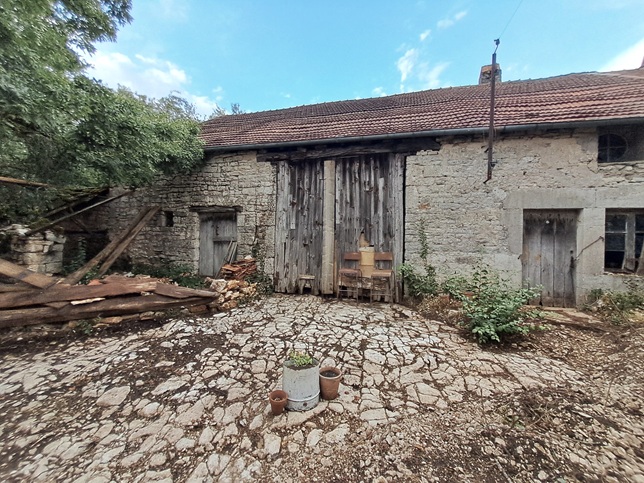
Au Piémont is an evolving site for artistic research, material experimentation, production, and exchange, situated in the rural landscape of eastern France. Developed across living, working, and outdoor environments, the project forms a long-term framework for spatial experimentation, collaborative encounters, and situated forms of practice.
Initiated in spring 2026, the site is being developed to simultaneously act as a production environment, research context, and hosting structure, bringing together material investigations, environmental processes, and interdisciplinary exchange across different temporalities and scales.
2026 – ongoing · Champlitte, Franche-Comté (FR)· more ·
NEURAL CONTINUA
architectural research framework
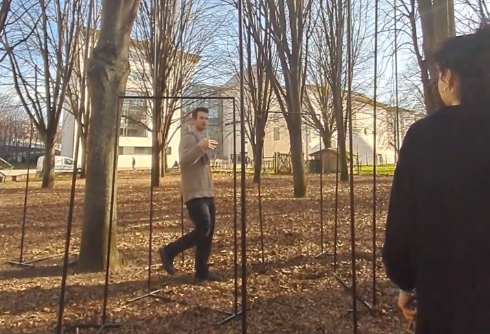
Neural Continua is an interdisciplinary research framework developed in collaboration with architect and neuroscientist Laura Ulloa. Situated between architecture, neuroscience, material research and artistic practice, the collaboration developed a theoretical and methodological framework for investigating continuities across adaptive systems, from neural processes and bodily perception to adaptive materials and architectural environments.
Rather than approaching cognition as an isolated property of individual subjects, Neural Continua examined perception as emerging through the continuous coupling of bodies, materials, environments and social interaction. Within this perspective, architecture becomes not only the setting for perception but an active participant in its formation through adaptive spatial and material configurations.
Developed through theoretical work and material experimentation, Neural Continua established a conceptual foundation for future investigations into environmentally coupled perception and adaptive architectural systems. While the collaboration concluded in 2026, the framework remains a documented contribution at the intersection of architecture, neuroscience and artistic research.
2026 · Paris (FR), Au Piémont (FR)· more ·
IN:DIFFERENCE
carte blanche
Two-month research-based project developed in the context of an open-ended invitation at Grey Room, Vienna. The project marked a new chapter in the practice, focusing on questions of differentiation, indifference, and the accumulation of material traces over time.
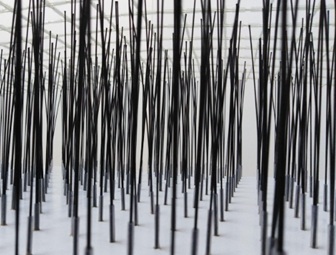
Working with the in-house fabrication of linear fibre-reinforced elements, the project investigated how material bias emerges through production, storage, and use. Newly fabricated elements were initially straightened through vertical suspension, temporarily suspending imprints arising from industrial fabrication, storage on bobbins, and long-term material creep.
The project unfolded through a continuous “breathing” between differentiation and indifference. While individual interventions left material traces that continued to shape the behaviour of each element, these traces were repeatedly dissolved within collective reconfigurations that resisted hierarchical accumulation. The residency took place across a hybrid setting combining living, working, and semi-public exhibition spaces, with regular public openings and collaborative interventions forming an integral part of the project.
2024 · Grey Room Studio Vienna (AT)· more ·
NONLOCAL RADIO
participatory audio platform
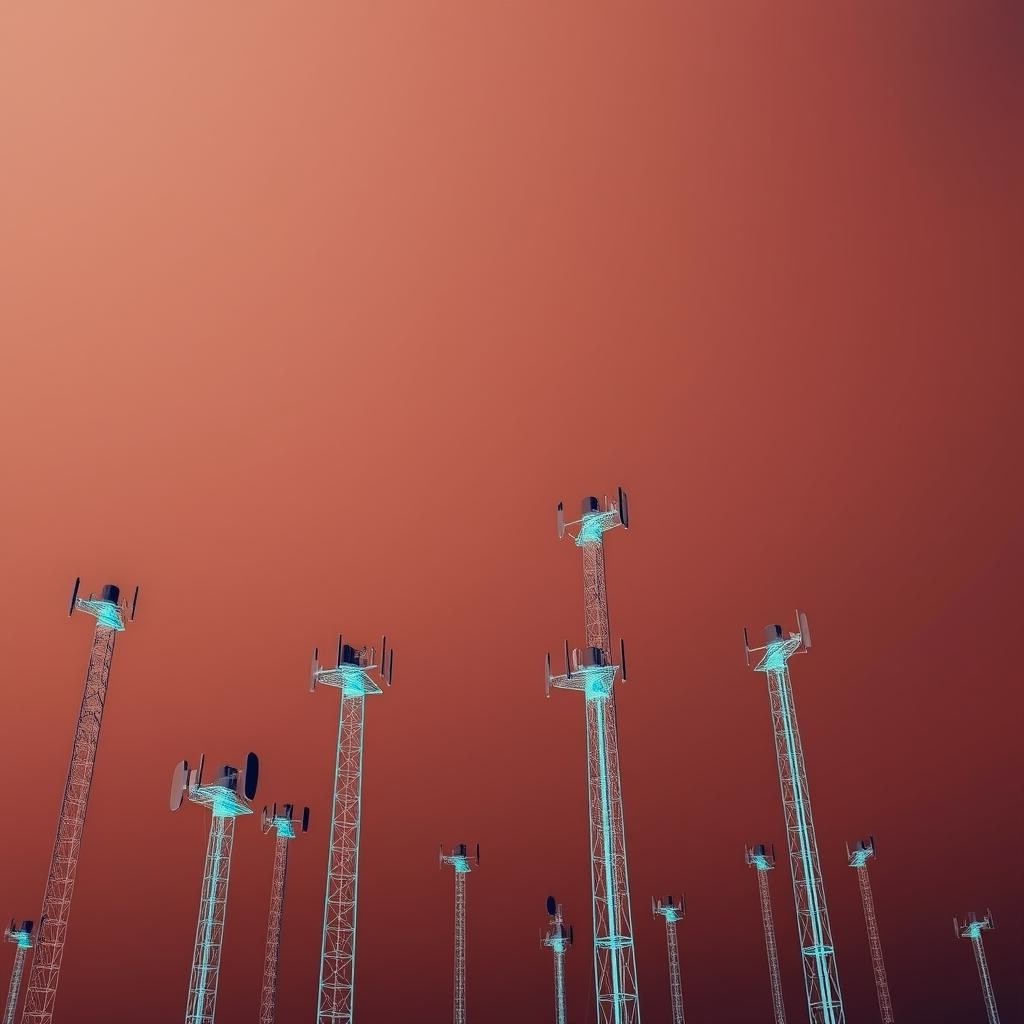
Participatory online radio platform and experimental audio environment dedicated to collective listening, distributed authorship, and non-centralised forms of cultural exchange. Nonlocal Radio operates through temporary overlaps between geographically dispersed participants, dissolving fixed distinctions between audience, contributor, and curator.
The platform functions less as a conventional broadcast channel than as an evolving relational infrastructure in which listening itself becomes a shared spatial and temporal condition. Contributions emerge from a wide range of artistic and sonic practices, including experimental music, field recordings, spoken word, environmental sound, live transmissions, and collaborative interventions.
Rather than positioning communication as a unidirectional act of transmission, Nonlocal Radio explores forms of co-presence and participation unfolding across distributed environments. The project forms part of a broader ongoing investigation into relational systems, collective processes, and non-hierarchical modes of cultural production.
2025 - ongoing · nonlocalradio.com· more ·
HANDLES / GRIFF
museum collaboration
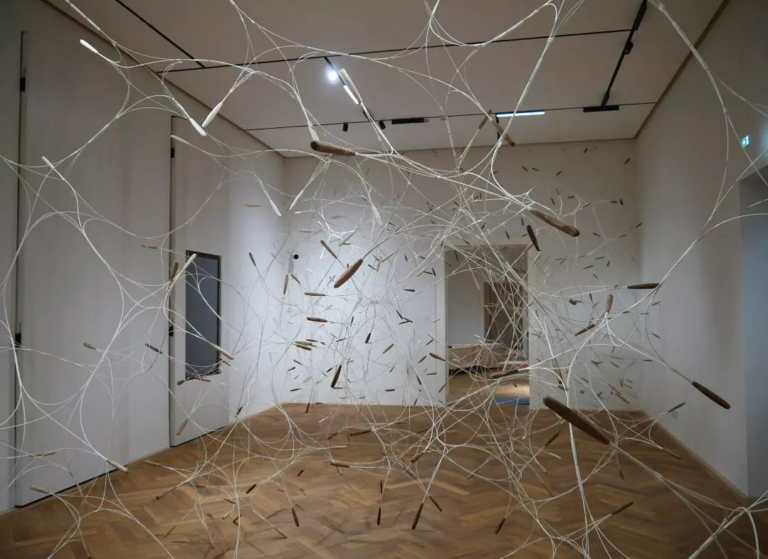
Large-scale participatory installation integrated into the permanent exhibition of the Kärnten Museum, located spatially between the museum’s natural history and cultural history sections. The work spans an entire exhibition room along the museum’s main circulation path, requiring visitors to pass through and physically engage with the structure.
The installation consists of a modular, adaptive system of interconnected hexagonal elements. Individual modules function as relational units, with open connection points extending into handles that invite bodily interaction. Participation becomes a structural condition of the work, framing questions of agency, responsibility, and co-participation in processes of environmental and societal change.
Beyond the installation itself, Handles / Griff constitutes a long-term collaboration with the museum. This includes the organisation of public discussions and roundtables within the installation space, as well as ongoing cooperation with scientific, cultural, and civil-society initiatives concerned with the Anthropocene. The collaboration extends beyond the exhibition period and contributes to the museum’s continuing engagement with questions of institutional responsibility in an ongoing present of change.
2022 - 2027 · Kärnten Museum, Klagenfurt (AT)· more ·
TEACHING PLASTICS
pedagogical research framework · lecture series
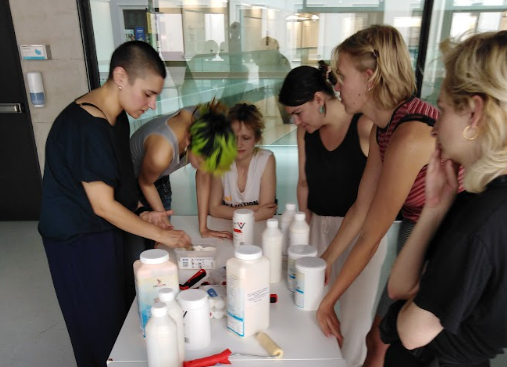
Three-year teaching and research framework developed at the University of Applied Arts Vienna within the Department of Textiles – Free, Applied and Experimental Artistic Design. The project approached plastics not as a fixed category of industrial materials, but as a broad field of material, structural, environmental, and cultural inquiry.
Teaching focused on plastics through the lens of textile logic and polymeric organisation, linking molecular structures, reticular systems, and material behaviour across scales. Rather than positioning plastics solely through narratives of rejection or ecological nostalgia, the framework aimed to develop forms of material literacy capable of engaging critically and constructively with the realities of contemporary material culture.
The teaching environment functioned as an open experimental platform in which students developed their own situated approaches to material practice. Alongside workshops, material experimentation, and structural investigations, the project included collaborative formats, invited guests, discussions, and roundtables addressing the social, ecological, and spatial implications of polymer-based systems.
2021-2024 · University of Applied Arts Vienna· more ·
NON-TRACELESS
solo exhibition
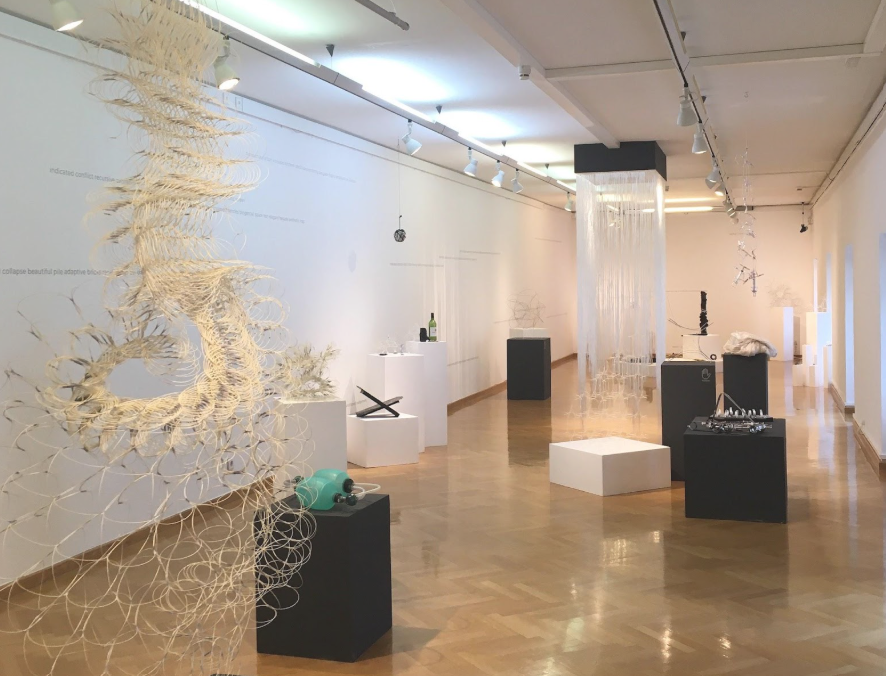
Solo exhibition exploring the inevitability of traces as a constitutive aspect of material systems, bodily presence, and spatial experience. The exhibition brought together a multiplicity of sculptural and interactive objects developed from responsive material systems, none of which conveyed a fixed or self-contained meaning in isolation.
Rather than locating meaning within individual objects, the exhibition was structured around the path taken by visitors through the space. Sequence, direction, and manner of encounter actively shaped the structural and perceptual character of the works. Participation extended beyond interpretation to material interaction, with visitors invited to touch selected works, allowing physical traces to accumulate over time.
Non-Traceless functioned both as a continuation of material research developed during a residency at Cité internationale des arts, Paris, and as a conceptual precursor to later long-term work addressing landscape plasticities and Anthropocene-related questions.
2021 · Stadtgalerie Klagenfurt (AT)· more ·
CUMULATIVE RETRANSLATION
research residency
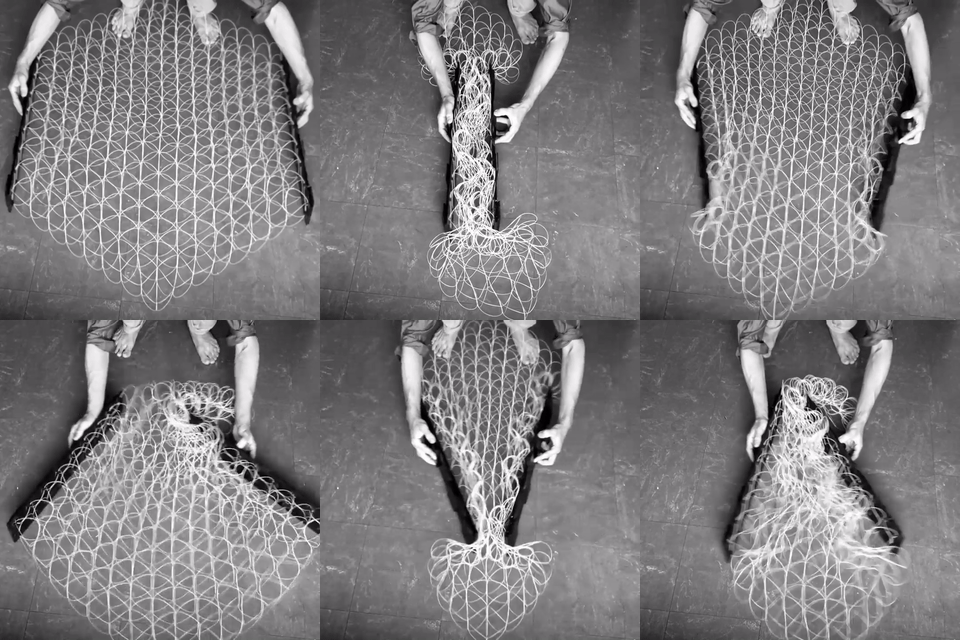
Research-oriented residency in which questions of material learning and memory were articulated explicitly as a central focus of the work. The project investigated how repeated interaction, deformation, and environmental coupling become imprinted in material behaviour, producing cumulative effects analogous to learning processes within adaptive, bending-active arrangements.
Working with responsive structures and their interlacing with other media – including airflow – the residency explored how material memory and shape memory could be extended toward functional forms of responsiveness. While initiated around a specific structural system, the residency unfolded in an open and exploratory manner, expanding the inquiry across a broader range of materialities and through sustained exchange with artists from other disciplines.
2020 · Cité internationale des arts, Paris (FR)· more ·
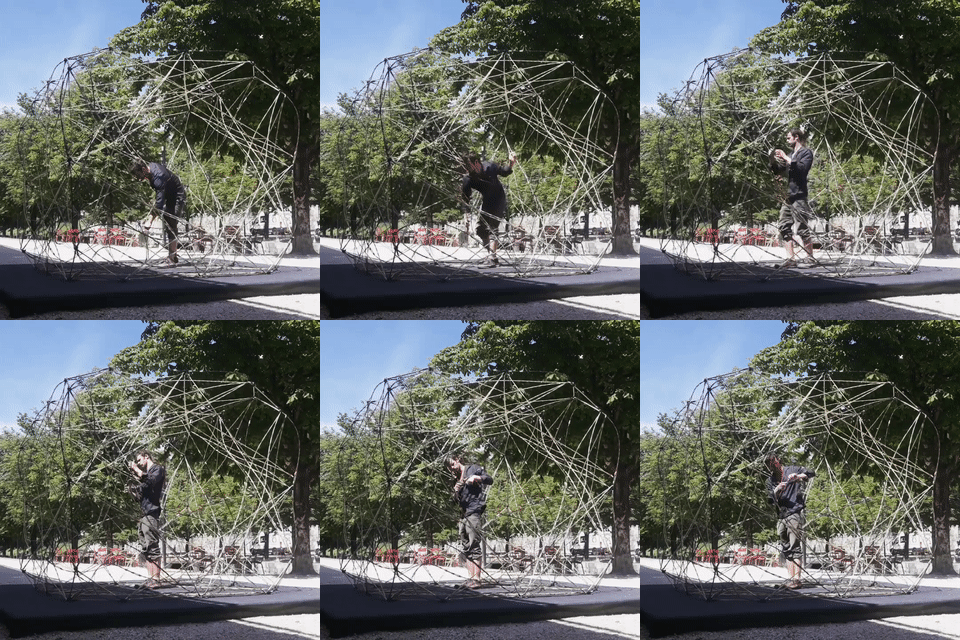
BÜNDELUNG
site-responsive installation
Participatory, site-responsive installation developed for a socially charged public space characterised by overlapping and often conflicting encounters. The work responds to the site through both its physical location and the diverse social narratives associated with it.
Structurally, the installation is based on an adaptive configuration derived from a four-dimensional cube (tesseract), realised through branching linear elements. This transformable internal structure is enclosed within a stabilised cubic frame whose exterior appears rigid and closed. Only upon entering does the internal openness and transformability become apparent, mirroring the site’s social dynamics. The internal configuration was informed by conversations and interviews conducted on site.
2020 · Lendspiel, Klagenfurt (AT)· more ·
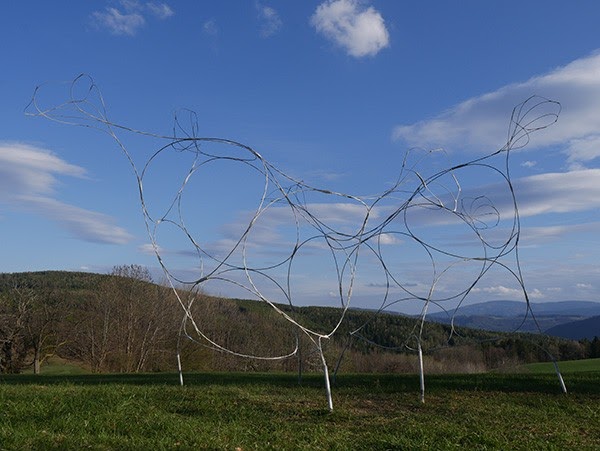
SPANNUNGSFELDER
site-responsive installation
Site-responsive, walk-in sculptural installation developed for an elevated landscape site on the eastern flank of the Austrian Alps. The work responds to the site’s distinctive horizon line – a primary stabilising element of spatial perception – by structurally “breaking” it into two separating hemispherical formations.
The installation consists of two permeable, inhabitable sculptural bodies whose curved outer shells reframe the surrounding landscape according to the visitor’s position and movement. Through bodily navigation, visitors actively participate in reconfiguring their spatial orientation and relationship to the site.
2019 · Kunst in der Landschaft, Gut Gasteil (AT)· more ·
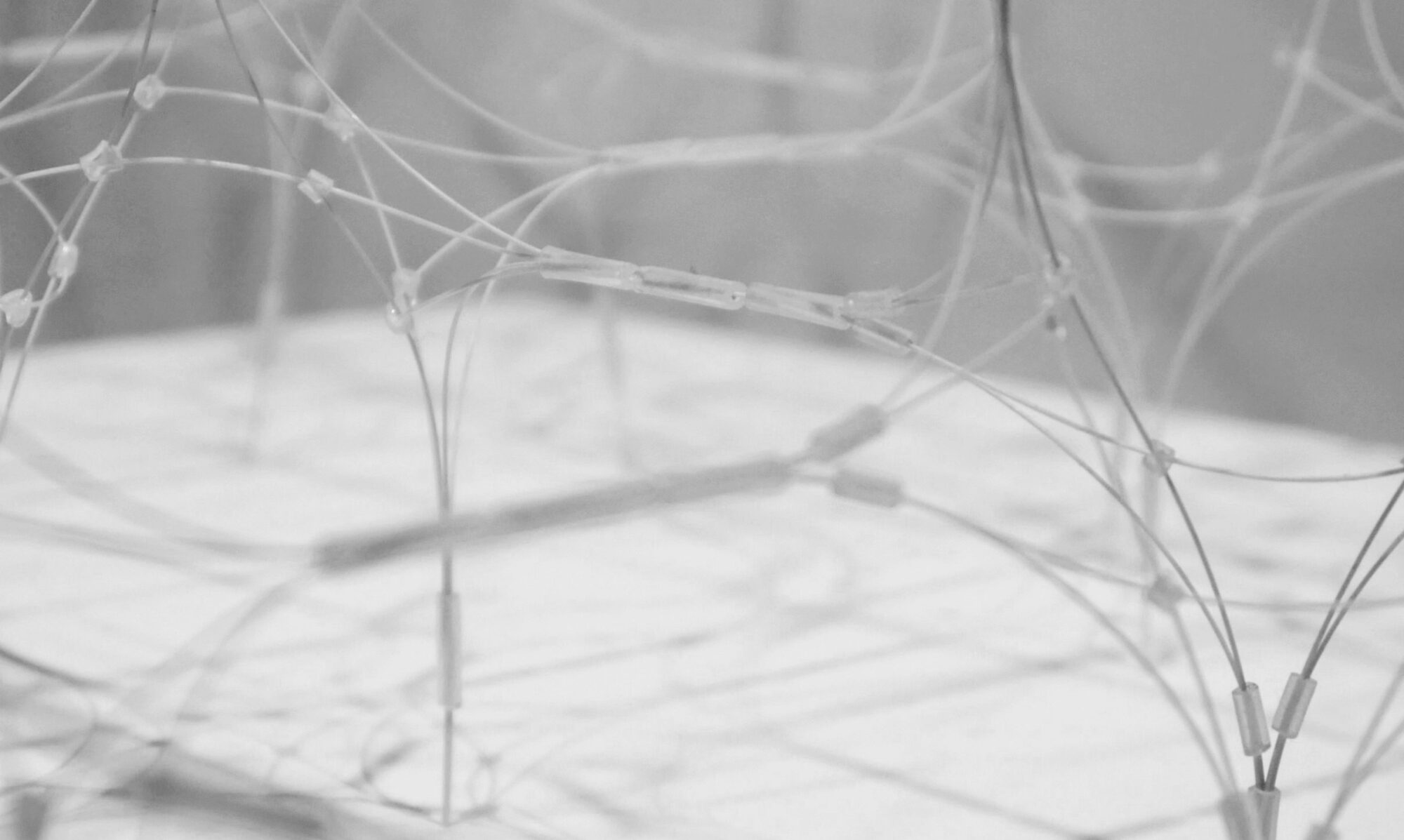
EVOLVING STRUCTURES
open-experimental structural research
Evolving Structures is an ongoing framework for experimental structural research developed initially in the context of architectural studies and continuously expanded through artistic practice, material experimentation, and spatial intervention. The project investigates structures not as fixed solutions derived from predefined intentions, but as evolving systems emerging through iterative interaction between material behaviour, environmental conditions, and situated experimentation.
Working primarily with lightweight, bending-active, and transformable arrangements, the framework develops structures through open-ended feedback processes in which unexpected side effects, instabilities, and emergent mechanisms actively inform further development. Rather than suppressing deviation in favour of optimisation, the process treats unforeseen behaviours as generative potentials capable of reshaping the trajectory of the work itself.
The project forms an important methodological foundation for later investigations into adaptive material systems, distributed agency, landscape plasticities, and co-responsive spatial environments.
ongoing since 2014 · Vienna University of Technology (AT)· more ·
© 2026, Kristoffer Stefan